How to tell whether men’s hair blocks are made of human hair
How to tell whether men’s hair blocks are made of human hair
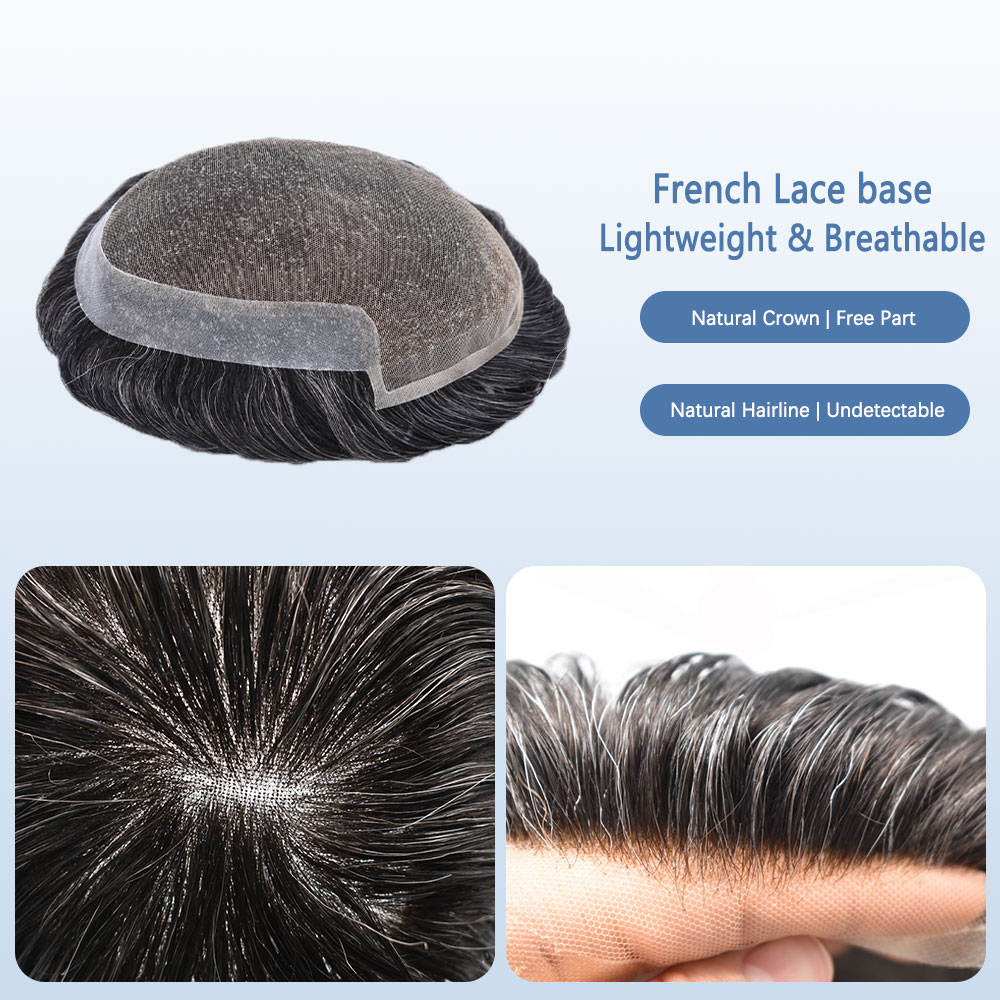
Appearance and gloss
Human hair shows a soft luster under natural light, with a non-dazzling gloss and rich layers. There is a natural hair scale structure on the surface of the hair, and the light reflection is relatively dispersed. Synthetic hair often presents plastic-like highlights, which are uniform and stiff, and may produce an unnatural reflective effect under strong light.
Feel and texture
Real human hair feels smooth and delicate, and you can feel the subtle texture on the surface of the hair when you touch it with your fingertips. The hair has moderate elasticity and moderate resistance when combing. Synthetic hair is relatively rough to the touch, hard in texture, prone to static electricity when combed, and has stiff elasticity.
Burning test
When a small amount of hair was taken for a burning test, real hair burned slowly, the flame was yellow, accompanied by a smell similar to burning feathers, and the ashes were in the form of black powder, which can be broken into pieces when lightly twisted with fingers. Synthetic hair burns quickly, the flame is often tinged with blue edges, emits the pungent smell of burning plastic, and the ashes condense into hard particles.
Hair structure observation
Use a high-power magnifying glass to observe the ends of the hair. You can see the natural hair scale structure of real hair. There are slight differences in the diameter of the hair and there may be natural transitions in color. The surface of synthetic hair is smooth and even, the diameter is exactly the same, and the color lacks gradation changes.
Water test
Immerse the hair strands in clean water. The weight of real hair will increase after absorbing water, and the diameter of the hair will expand slightly. It will return to its original shape after drying. Synthetic hair has poor water absorption properties. It often floats or sinks slowly after entering water. It dries quickly and does not change its shape obviously.
Temperature response
Human hair is sensitive to temperature changes. When using high-temperature styling tools, it will produce a protein burnt smell similar to natural hair, and moderate high temperatures can change the shape of the hair. Synthetic hair is prone to melting and curling when exposed to high temperatures, producing obvious chemical odors, and high-temperature damage is irreversible.
Color change
Human hair can be dyed with conventional hair dyes, and the color will be absorbed naturally, and the hair quality will change accordingly after dyeing. Synthetic hair is difficult to color, dyes have limited effectiveness, and the dyeing process can damage the hair structure.
Price and Source
The price of high-quality human hair products is significantly higher than that of synthetic hair, and merchants usually provide clear origin information, such as hair quality characteristics in different regions such as Europe and Asia. Synthetic hair products are less expensive, and the raw material descriptions are often vaguely stated as "high-temperature yarn" or "synthetic fiber."
Long-term use performance
As time goes by, human hair products will experience normal wear and tear similar to natural hair, and the gloss will gradually soften, and can be restored to their original state through professional care. Synthetic hair tends to become dry, frizzy, and tangled after being used for a period of time, and care products have limited improvement effects.